
Flooring is one of the most expensive investments in any building, whether residential or commercial. What can you do to get the most life out of your brand new carpet?
First of all, allow me to congratulate you on choosing to install carpet despite all the bad press it seems to have gotten in the past couple of decades, accusing carpet of things like increasing allergies and decreasing indoor air quality. Either you were sold on carpet instead of hard flooring by a very knowledgeable salesman or else you were already aware of its many benefits in most situations.
Now that it’s installed and you’re enjoying those benefits, it would be wise from day one to make sure you can enjoy them for as long as possible given the size of your investment.
Here is what I would suggest, starting with the most important.
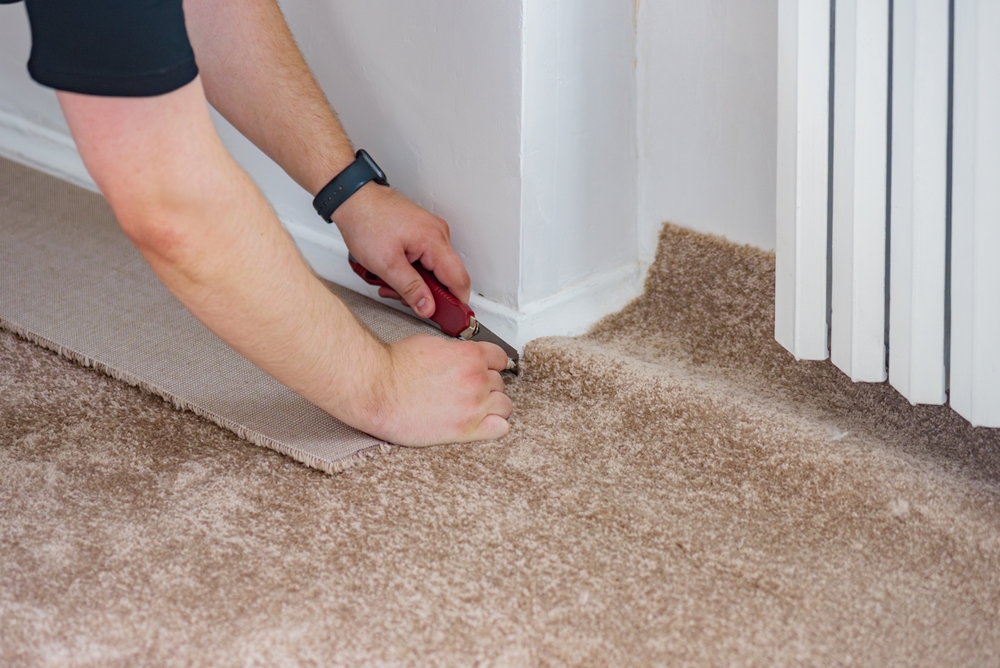
Learning how to take good care of your new carpet is the key to getting the most life out of your big investment.
1) Install mats in all entryways
There are two main enemies of carpet: soil particles (dirt, sand, etc.) and foot traffic. At the entry to a building, your main goal is to eliminate as many soil particles being dragged further into the building as much as possible. These particles, once ground into a carpet (and even hard flooring) by foot traffic, act like sandpaper, eventually causing permanent damage to carpet fibers at the microscopic level. This damage creates a dullness in the carpet known as “traffic lane gray.” Because this damage can’t be fixed by any sort of cleaning, you want to do everything you can to prevent it from starting.
Mats are the key to keeping in check the two main enemies of carpet: soil particles and foot traffic.
If possible, you want a mat inside AND outside every entry. There are all kinds available, but try to get ones that specify dirt and/or water removal/retention.
I would advise AVOIDING mats made from coir fibers or bristles, especially outdoor mats. Within a few months, especially after outdoor exposure, the coir sheds terribly (based upon personal experience) and the fibers get dragged all over the place.
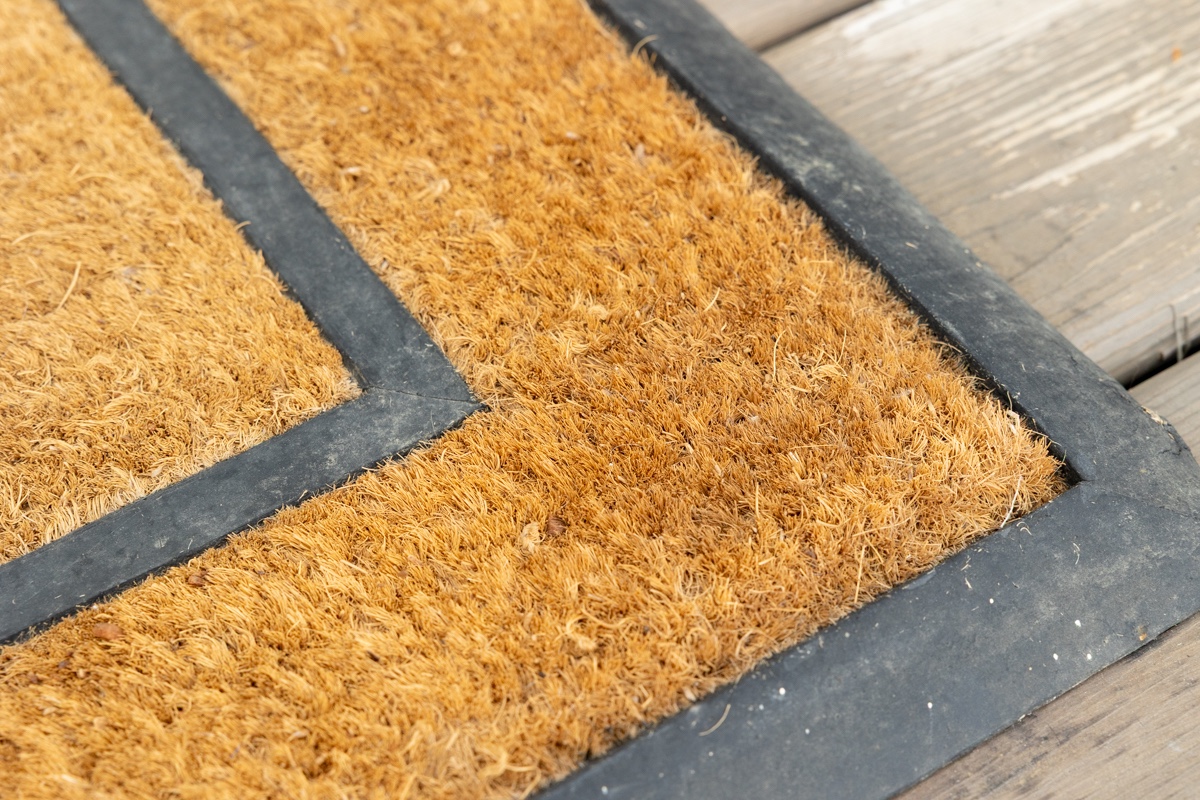
Coir fiber mats are not advised for entryways due to excessive shedding. Click photo to enlarge.
Indoors, you also want an entry mat whether the flooring is hard or carpeted, but make sure the base is grippy enough if it’s on hard flooring.
In a home, you must be vigilant to make sure that people take off their outdoor footwear at each entry. If this can’t be avoided, as in a commercial building, then your goal should be to have little to no soil particles left on footwear by the time people step onto your actual carpet.
How can you achieve this? There have been studies done and even book chapters written on the amount of soil retained per length of mat after so many footsteps. You can search for these if you wish, but the easiest rule-of-thumb is to find the largest/longest mat possible for your entry area. Put another way, get a mat that covers as much as the entry area as possible for as far away from the door as possible.
Here’s an example in a church. Some might consider this overkill – only two-thirds of this runner mat is pictured! – but the pastor has wisely realized that the tens of thousands of dollars’ worth of carpet in the main part of the building is a lot more expensive and difficult to replace than a runner mat that costs a few hundred dollars.
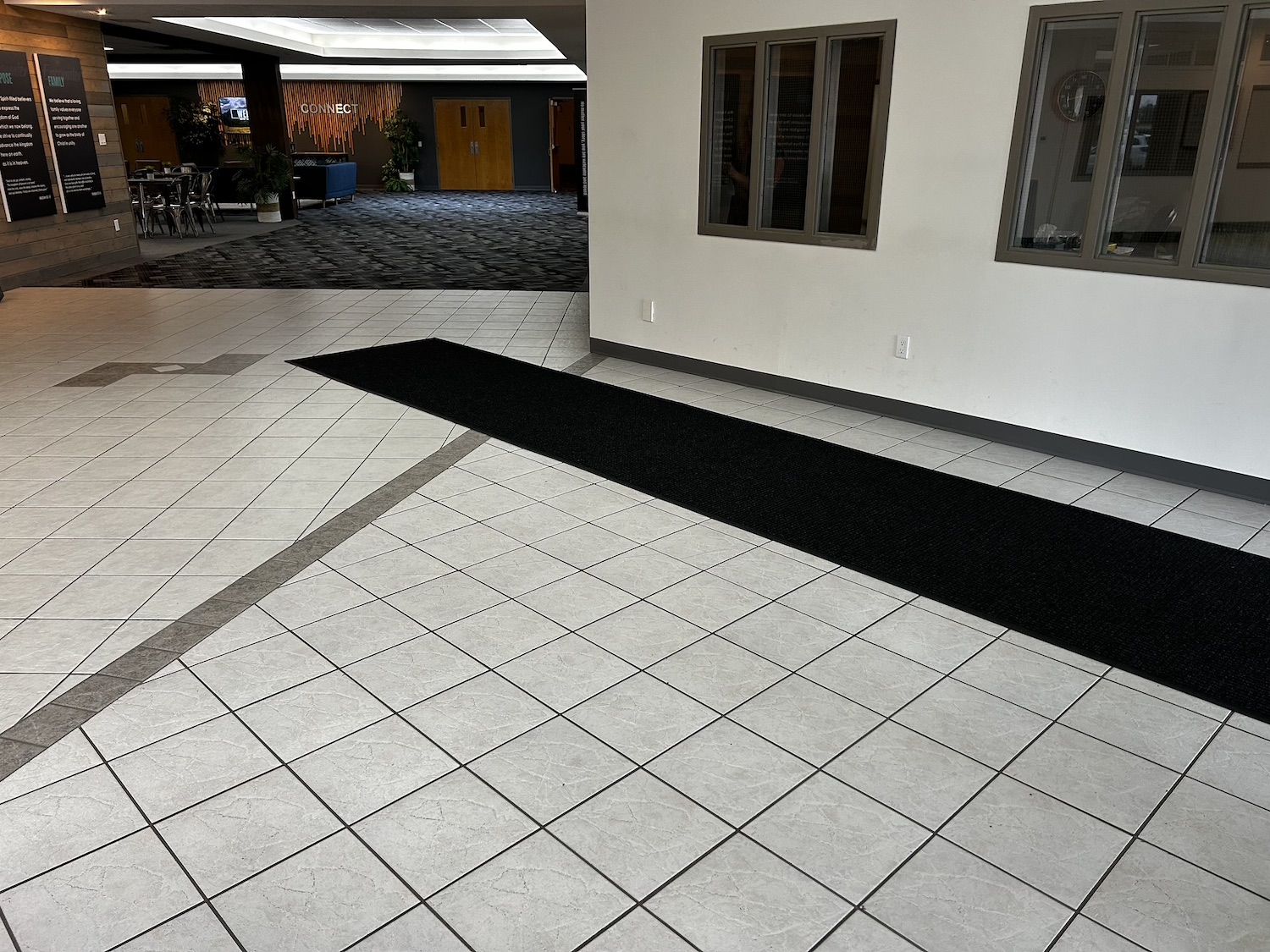
This extra-long entryway runner mat in a church will ensure that little to no soil particles from outside will remain on footwear to damage the carpet in the background. Click photo to enlarge.
Note the brand-new carpeting to the upper left. By the time people reach the end of the very long entryway runner mat, there are very few soil particles left on footwear even in the worst of weather. The runner also follows the path that most people take into the church. People who go in other directions have a good 25 feet or so of tile flooring before they reach the nearest other carpeted area, enough to also remove a good amount of footwear soiling, although a runner mat to that area would also be preferable.
By virtue of design, some entryways leave very little room for a large enough mat. That’s where you would need to also put a mat that covers some of the carpet away from the entry.
Rule of thumb: get a mat that covers as much as the entry area as possible for as far away from the door as possible.
2) Install mats in other high-traffic areas
In most homes in which I clean carpets, I see a lot of damage on carpet at the bottom of staircases. I also see them in hallways closest to entryways. A mat on carpet might not make sense aesthetically, but practically they make the best sense because they’re easily replaceable. They take the abuse instead of the carpet underneath that’s very expensive to replace.
It’s not necessary to place a runner mat along the length of an entire hallway, just along the few feet closest to an entryway.
Mats in high-traffic areas take the abuse instead of the carpet underneath that’s very expensive to replace.

A mat at the bottom of this staircase would have likely prevented the permanent damage to the carpet known as “traffic lane gray.” Click photo to enlarge.
3) Make vacuuming a priority
You should vacuum your residential carpet at least once per week, more in high-traffic areas (including vacuuming/shaking out any mats). Commercial carpets in high-traffic areas should ideally be vacuumed daily. I won’t go into more details because this post explains the reasoning at length.
You also need to use a proper vacuum. You’re first of all wise to consider one that is CRI certified. Also, a stick vacuum is only good for hard flooring no matter what amount of marketing hype claims otherwise. You need a good upright, canister, or central vacuum to properly clean carpet.
A stick vacuum is only good for hard flooring no matter what amount of marketing hype claims otherwise.
4) Get your carpet professionally cleaned
Even the best and most powerful vacuum cannot clean a carpet down to the backing/base. Only the equipment used by certified professionals can do this. And no, buying or renting something like a Rug Doctor will not give you anywhere near the same results.
The main enemy is the buildup of soil particles that will cause abrasion of the carpet fibers. Even if your carpet doesn’t look dirty, you can’t see the microscopic soil particles that will damage your carpet fibers with repeated foot traffic. But you can see the larger particles if you dare to spread some of the fibers apart.
As with vacuuming, I won’t go into more details because the second part of this post explains the reasoning behind the necessity to get regular “restorative” carpet cleaning done, plus how often to get it done.
Even if your carpet doesn’t look dirty, you can’t see the microscopic soil particles that will damage your carpet fibers.
Some thoughts about professional carpet cleaning
When it comes time to hire a professional carpet cleaning company, did you know that low-moisture carpet cleaning (VLM or very-low moisture) is your wisest choice in all but the most extreme situations? Low moisture means quick dry times, often several times faster than traditional forms of carpet cleaning (shampooing, steam cleaning, truck-mount cleaning, spray extraction, hot-water extraction, etc.).
VLM carpet cleaning is your wisest choice in all but the most extreme situations.
This results in less inconvenience waiting for carpet to dry, often only a couple of hours at most compared to often a day or more. You also won’t need to run noisy fans or keep windows or doors open. And in the dead of winter, there is minimal frost build-up on inside windows.
Low moisture also means less chance of water damage to carpet underlay and flooring and also basically no chance for mold growth.

VLM carpet cleaning uses way less water – and the top-rated systems use brushes (not pads) to gently clean right to the carpet base and also use non-toxic cleaners.
Many of the traditional “steam” forms of carpet cleaning also involve running hoses through an open door during the whole time it takes to do the cleaning, not ideal if the weather isn’t ideal or if you’re not fond of outdoor things (bugs, rodents, pollen, dust, etc.) getting into your house. VLM carpet cleaning systems are all self-contained, meaning only opening a door briefly to get the equipment in and then out.
That said, Neat Freak Cleaning has adopted a more hybrid approach. I’ll use spray extraction on carpets with an unknown professional cleaning history and/or which have not been regularly maintained for an initial deep clean, but then use VLM as the perfect choice for follow-up maintenance cleanings with the Touch-Up Package. But I’ll use VLM for carpets with a known professional cleaning history that are well maintained.
If you live in Southeast Alberta, Canada, click here to learn more about my carpet cleaning services and also the VLM difference!

Neat Freak Cleaning services Brooks, Newell County, and Southeast Alberta, Canada. We provide residential & commercial carpet and rug cleaning and also auto detailing. Contact us today to learn more.
Share this: